Advanced Diploma in Information Technology (ADIT) - 15 Month Program (Updated)
Course Duration: 15 Months (Three Semesters, 5 months each)
Course Objective: To provide an extensive, high-level foundation across essential IT domains (Programming, Networking, Database, Web) and incorporate vital computerized financial accounting and digital graphics skills, preparing graduates for diverse technical, analytical, and design-integrated roles.
ADIT Course Subjects and Semester-wise Syllabus (15 Months)
The course is structured around five core modules, including the new Graphics Course.
Semester I (Months 1-5): IT Foundations & Business Applications
This semester establishes computer literacy, professional documentation, and core accounting skills.
|
Core Module |
Subject Code |
Subject Name |
Key Topics Covered |
Practical Focus |
|
IT Fundamentals & Office Automation |
ADIT 101 |
Computer Architecture & OS |
Hardware components (CPU, Memory, Motherboard), OS functions, Windows/Linux file systems, CLI basics, Basic troubleshooting and maintenance. |
OS installation/configuration, System maintenance, File management utilities. |
|
IT Fundamentals & Office Automation |
ADIT 102 |
Professional Office Suite |
Advanced MS Word (Reports, Mail Merge), MS Excel (Pivot Tables, VLOOKUP, Data Validation), MS PowerPoint (Design principles), Technical documentation standards. |
Budgeting spreadsheets, Automated technical reports, Professional presentations. |
|
Financial Accounting (with Tally) |
ADIT 103 |
Financial Accounting Principles |
Golden Rules of Accounting, Double-Entry System, Journal, Ledger, Trial Balance, Final Accounts (P&L, Balance Sheet), Depreciation. |
Manual preparation of financial statements. |
|
Financial Accounting (with Tally) |
ADIT 104 |
Computerized Accounting (Tally Prime) |
Company setup, Masters (Ledgers, Groups), Inventory Management, Voucher Entry (Sales, Purchase, Contra, Journal), GST/VAT basics, Report generation. |
Full cycle accounting simulation for a mock business in Tally. |
Semester II (Months 6-10): Programming, Design, and Database Management
This semester integrates logical reasoning, fundamental programming, digital design, and data management.
|
Core Module |
Subject Code |
Subject Name |
Key Topics Covered |
Practical Focus |
|
Programming and Software Development |
ADIT 201 |
Programming Fundamentals (C & OOP Intro) |
Algorithms, Flowcharts, C Language basics, Functions, Arrays. Introduction to OOP concepts (Classes, Objects) using C++ or Python. |
Writing, compiling, and debugging programs, basic OOP class implementations. |
|
Programming and Software Development |
ADIT 202 |
Digital Graphics and Design |
1. Core Concepts: Raster vs. Vector, Color Theory (RGB, CMYK), Resolution, File Formats. 2. Software (Photoshop/GIMP): Image editing, Retouching, Layers, Filters, Masking. 3. Software (Illustrator/CorelDraw): Logo design, Vector illustration, Typography, Layout composition. |
Creating corporate identity assets (logo, business card), Photo editing, Simple poster design. |
|
Web Technologies & Database Management |
ADIT 203 |
Database Management Systems (DBMS) |
DBMS architecture, Data modeling (E-R Diagrams), Normalization (up to 3NF). SQL: DDL, DML, basic Joins, and Subqueries. |
Designing a database schema, Executing complex queries using MySQL or PostgreSQL. |
|
Web Technologies & Database Management |
ADIT 204 |
Front-End Development Basics |
HTML5 (Semantic Structure, Forms), CSS3 (Styling, Flexbox layout), Introduction to JavaScript (Variables, DOM manipulation). |
Developing static, responsive web layouts, integrating graphics from ADIT 202. |
Semester III (Months 11-15): Networking, Security, and Project Integration
This final semester covers IT infrastructure and integrates all acquired skills into a major project.
|
Core Module |
Subject Code |
Subject Name |
Key Topics Covered |
Practical Focus |
|
Networking and Security |
ADIT 301 |
Data Communication & Networking |
Network topologies, OSI & TCP/IP models, IP Addressing (Subnetting, IPv4/IPv6 basics), Routing principles, Network devices (Hubs, Switches, Routers). |
Configuring a basic network (conceptual), Using diagnostic tools (ping, traceroute). |
|
Networking and Security |
ADIT 302 |
IT Security & Cloud Computing |
Threats (Malware, Ransomware), Firewalls, Cryptography basics, Digital Signatures, IT Ethics. Introduction to Cloud models (SaaS, PaaS, IaaS) and basic cloud services. |
Implementing security policies, Data encryption/decryption practice. |
|
Web Technologies & Database Management |
ADIT 303 |
Advanced Web & Scripting |
Advanced JavaScript (AJAX, JSON), Introduction to a server-side language/framework (e.g., Node.js or PHP basics), Connecting web forms to a database. |
Building a simple CRUD (Create, Read, Update, Delete) web application. |
|
Integrated Project |
ADIT 304 (P) |
Integrated Major Project & Viva Voce |
Students must design and implement a comprehensive software solution (e.g., a dynamic website with graphics, database backend, and inventory module) integrating Programming, Graphics, DBMS, and Web Technologies. |
Submission of project report, source code, and final presentation/demonstration. |
Minimum Qualification (Eligibility Criteria)
To enroll in the ADIT program, candidates typically need to meet the following criteria:
|
Criteria |
Requirement |
|
Educational Qualification |
Successful completion of 10+2 (Higher Secondary Examination) from any recognized board or equivalent vocational qualification. |
|
Aptitude |
Basic familiarity with logical reasoning and mathematics is recommended. No prior graphics experience is required. |
|
Minimum Percentage |
Typically 45% - 55% aggregate marks (varies by institution). |

Course Code : S-ACC
Course Code : S-DCA
Course Code : S-ADCA
Course Code : S-ADIT
Course Code : ADITSM

Course Code : S-BOC

Course Code : M-TALLYPRIME008
Course Code : M-CBC 01
Course Code : M-ADIT004
Course Code : M-DCA002
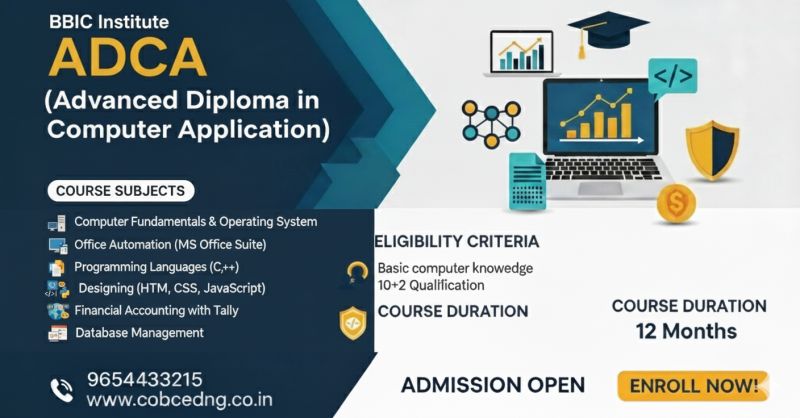
Course Code : M-ADCA002
Course Code : M-ADITSM005
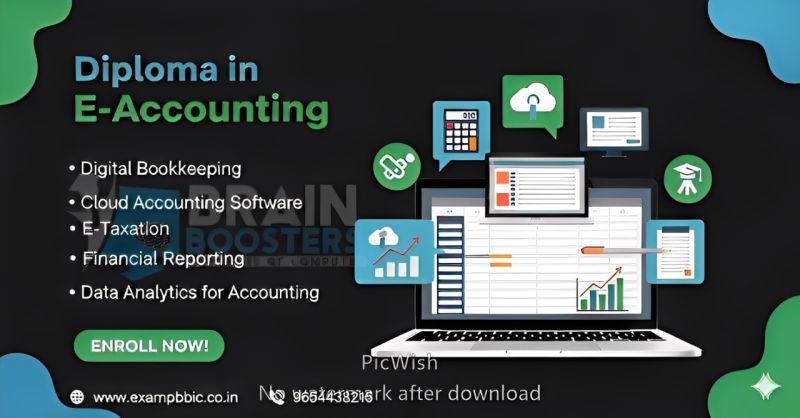
Course Code : M-S-DEA01
Course Code : M-ACCSC008