
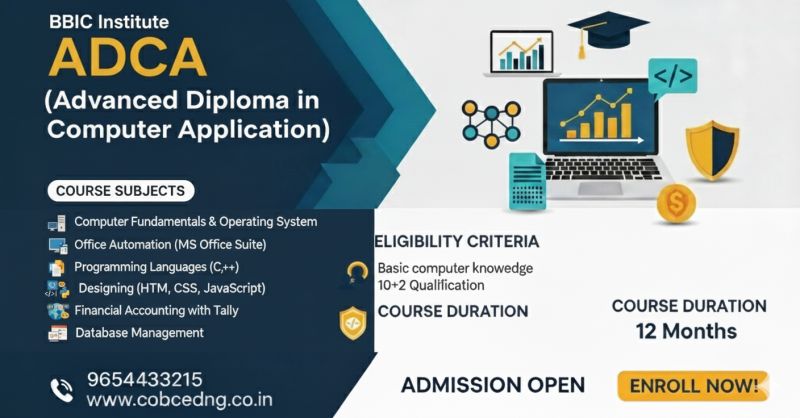
Advanced Diploma in Computer Applications (ADCA) - 1 Year Program
Course Duration: 12 Months (Two Semesters, 6 months each)
Course Objective: To provide comprehensive training in core computer applications, essential office automation, fundamental programming concepts, and database management, preparing students for technical and administrative roles.
ADCA Course Subjects and Semester-wise Syllabus
The course is divided into two semesters, with Semester 2 focusing on advanced and technical subjects.
Semester I (Months 1-6): Foundation and Business Applications
|
Subject Code |
Subject Name |
Key Topics Covered |
Practical Focus |
|
ADCA 101 |
Computer Fundamentals & OS |
Computer architecture, generations of computers, input/output devices, memory hierarchy. Operating System principles, file management, security, and basic troubleshooting (Windows/Linux Intro). |
Practical: Deep dive into Windows/Linux utilities, installing/managing software, network setup basics. |
|
ADCA 102 |
Office Automation & Internet |
MS Word: Advanced documentation, Mail Merge, collaborative tools. MS Excel: Advanced formulas (VLOOKUP, Pivot Tables), Data Analysis, Charting. MS PowerPoint: Professional presentation design, multimedia integration. Internet & Digital Skills: Cloud services, e-commerce, cyber hygiene. |
Practical: Creating dynamic Excel sheets for business, developing complex Mail Merge templates. |
|
ADCA 103 |
Financial Accounting with Tally |
Accounting Principles: Journal, Ledger, Trial Balance, Final Accounts (P&L, B/S). Tally Prime: Company creation, Chart of Accounts, Voucher Entry, Inventory management, GST/VAT implementation, Report generation. |
Practical: Full cycle accounting simulation for a mock company in Tally Prime. |
|
ADCA 104 |
Programming Logic & C Language |
Algorithms and Flowcharts, Introduction to structured programming. C Language basics: Data types, variables, operators, Control structures (if/else, switch), Loops (for, while), Arrays, basic functions. |
Practical: Writing, compiling, and debugging simple programs in C to solve logical problems. |
Semester II (Months 7-12): Advanced Topics & Technical Skills
|
Subject Code |
Subject Name |
Key Topics Covered |
Practical Focus |
|
ADCA 201 |
Database Management Systems (DBMS) |
Introduction to DBMS, Data models (E-R Model), Normalization (1NF, 2NF, 3NF). SQL: Data Definition Language (DDL), Data Manipulation Language (DML), Joins, Subqueries, Stored Procedures (basic level). |
Practical: Designing a simple database schema (e.g., Inventory, Student Records) and executing complex SQL queries using MySQL or MS Access. |
|
ADCA 202 |
Web Designing Fundamentals |
HTML5: Structure, Semantic elements, Forms. CSS3: Styling, Box model, Layout techniques (Flexbox/Grid Intro), Basic responsiveness. JavaScript: Introduction to client-side scripting, DOM manipulation, Form validation. |
Practical: Developing a static, multi-page website with basic responsive design and client-side validation. |
|
ADCA 203 |
Advanced Excel & Reporting |
Advanced Data Modeling, VBA Macros (Recording and editing simple code), Power Query introduction, Advanced Conditional Formatting, Scenario Manager. |
Practical: Automating simple repetitive tasks using Macros, creating complex dashboards for reporting. |
|
ADCA 204 |
IT Security & Networking |
Networking concepts (LAN, WAN, Topologies), OSI Model layers (Introduction), IP Addressing (basics). Cyber threats (Malware, Spyware), Firewall concepts, Data backup and recovery strategies, Ethical Hacking Introduction. |
Practical: Configuring basic network settings, performing data backups, and using network diagnostic tools. |
|
ADCA 205 |
Integrated Major Project |
Students develop a complete software solution (e.g., a small Inventory System, an HR Management System, or a detailed business analysis) using the skills acquired from DBMS, C/Web Design, and Excel. |
Practical: Submission of project report, source code, and final presentation/demonstration (Viva Voce). |
Minimum Qualifications (Eligibility Criteria)
The ADCA is an advanced course and usually requires the student to meet one of the following criteria:
|
Requirement Category |
Description |
|
Path 1: Standard Entry |
Successful completion of 10+2 (Higher Secondary Examination) from any recognized board or equivalent. |
|
Path 2: Previous Certification |
Completion of a DCA (Diploma in Computer Applications) or an equivalent 6-month computer certificate course. |
|
Minimum Percentage |
Typically 40% - 50% aggregate marks (varies by institution). |

Course Code : S-ACC
Course Code : S-DCA
Course Code : S-ADCA
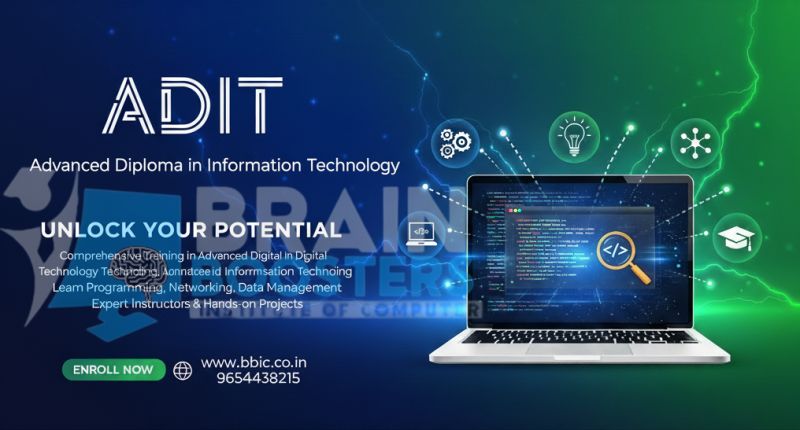
Course Code : S-ADIT
Course Code : ADITSM

Course Code : S-BOC

Course Code : M-TALLYPRIME008
Course Code : M-CBC 01
Course Code : M-ADIT004
Course Code : M-DCA002
Course Code : M-ADCA002
Course Code : M-ADITSM005
Course Code : M-S-DEA01
Course Code : M-ACCSC008